
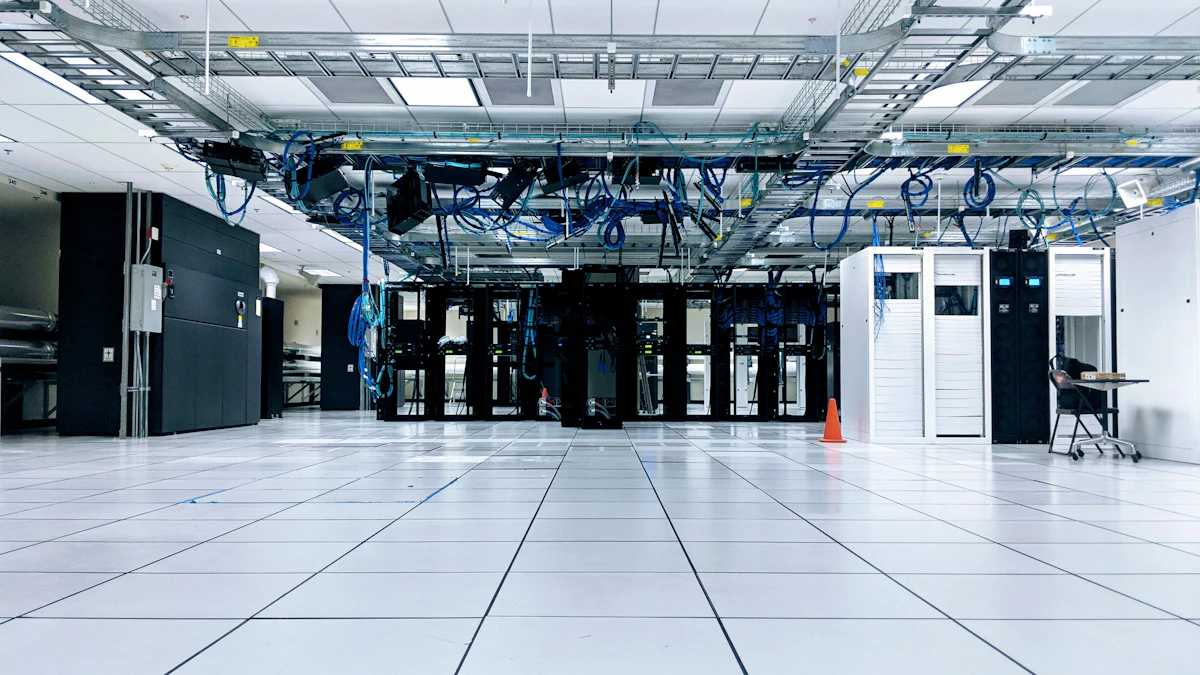
A practical cleaning schedule for data halls, subfloors and overhead areas — and how particle counts tell you whether the interval is right.
There is no single number that fits every facility. A colocation hall with customers walking through every day collects contamination faster than a sealed enterprise room that is visited once a week. What every facility does share is the same set of contamination sources: people and their shoes, packaging, construction work, and the outside air brought in by the cooling system.
A sensible starting schedule
Most facilities settle on a program with different intervals for different zones, rather than one deep clean a year:
- Entrances, tacky mats and high-traffic aisles: weekly or monthly
- White-space floors and cabinet exteriors: monthly or quarterly
- Underfloor (subfloor) plenum: once or twice a year
- Overhead cable trays, ladder racks and ceiling plenums: once a year
- After any construction, cabling project or equipment move: as an extra visit
Let measurements decide
The most reliable way to set the interval is to measure. A laser particle count before and after cleaning shows how dirty the room actually gets between visits. If a room is well inside ISO 14644-1 Class 8 when the crew arrives, the interval can stretch; if it is near the limit, it should shorten.
Signs a room is overdue
- Visible dust on cabinet tops, perforated tiles or the tops of equipment
- Grey intake grilles and filters that load faster than expected
- Debris, cable offcuts or packaging under lifted floor tiles
- Recent construction or remodelling with no cleaning afterwards
A written program, agreed once and followed on schedule, is also what auditors and customers ask to see. It turns cleaning from a reaction into a documented part of your maintenance plan.
Need help with your facility?
We clean data centers and critical spaces across Northern Virginia, Washington, DC and Maryland, to a written scope with documented results.
More articles
Standards · October 14, 2026
ISO 14644-1 Class 8, Explained for Data Center Managers
What the ISO 14644-1 cleanliness classes measure, why Class 8 is the usual target for data centers, and how a particle count is carried out.
Read article
Contamination · October 7, 2026
Zinc Whiskers: What They Are and How to Find Them
Zinc whiskers grow from some electroplated steel used in older raised floors and ceiling grids. Here is where to look and what to do if you find them.
Read articleRaised floors · September 29, 2026
Why Subfloor Cleaning Matters for Cooling
In a raised-floor data center the underfloor space is part of the air path. What collects there ends up in your equipment.
Read articleDiscuss your facility’s requirements
Tell us about the space, the scope you have in mind and your access windows. We will come back with questions, a walkthrough date or a proposal.