
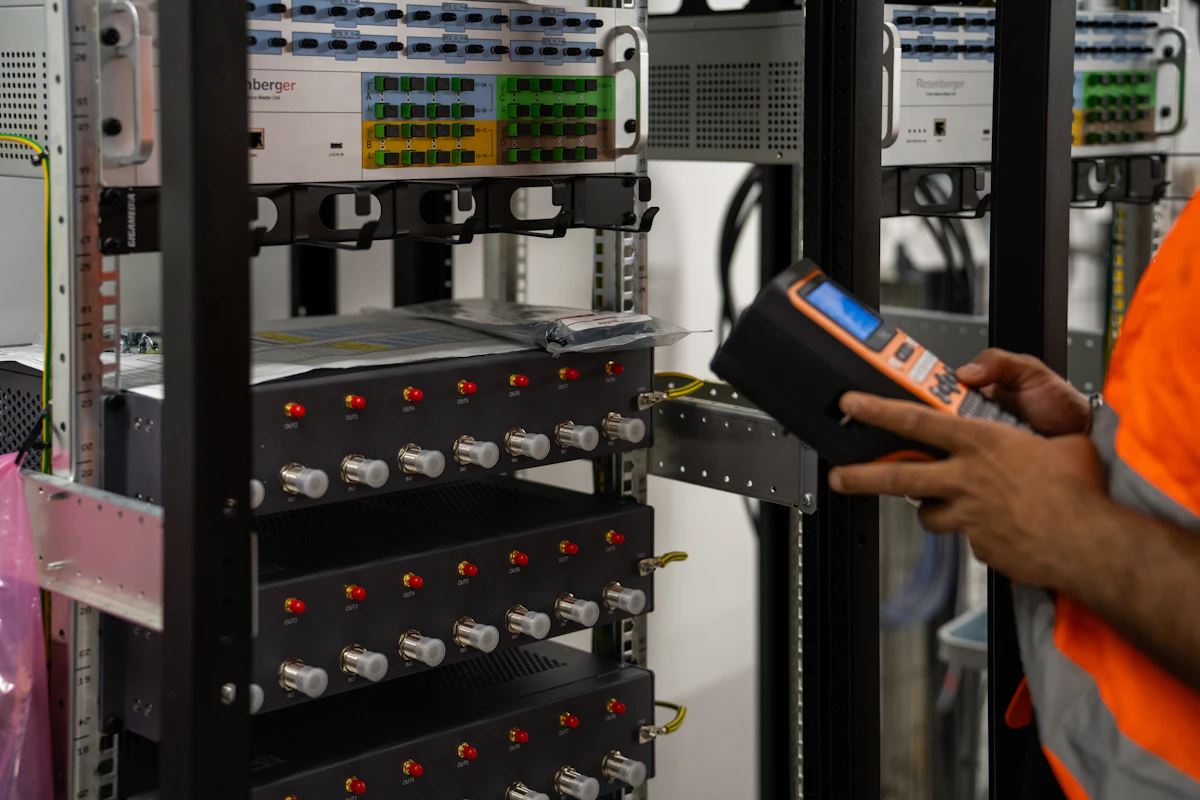
What the ISO 14644-1 cleanliness classes measure, why Class 8 is the usual target for data centers, and how a particle count is carried out.
ISO 14644-1 is the international standard for classifying how clean the air in a room is. It was written for cleanrooms, but equipment makers and the ASHRAE TC 9.9 guidelines borrow it as the yardstick for data centers, because it gives everyone the same numbers to talk about.
What the classes mean
Each class sets a maximum number of airborne particles per cubic metre of air, at several particle sizes. The lower the class number, the cleaner the room. Class 8 allows, per cubic metre:
- up to 3,520,000 particles of 0.5 µm and larger
- up to 832,000 particles of 1 µm and larger
- up to 29,300 particles of 5 µm and larger
For comparison, a human hair is roughly 50 to 100 µm across. The particles that matter here are invisible, which is exactly why they have to be counted rather than judged by eye.
How big is a micron?
One micron (µm) is a thousandth of a millimetre. The particles that damage equipment are far below what the eye can see — which is why we measure them.
Why Class 8 for data centers
Many hardware makers state in their environmental requirements that a data center should be kept at ISO 14644-1 Class 8 or cleaner. Fine dust settles on heat sinks and in fans, reduces cooling, and — combined with humidity — some particles can absorb moisture and become conductive or corrosive.
How a particle count works
- A calibrated laser particle counter draws in a known volume of air and counts particles in size channels such as 0.3, 0.5, 1.0 and 5.0 µm.
- The standard sets the minimum number of sample locations from the floor area of the room.
- Samples are taken at working height, spread across the space.
- The results are compared with the class limits and reported, location by location.
Need help with your facility?
We clean data centers and critical spaces across Northern Virginia, Washington, DC and Maryland, to a written scope with documented results.
More articles
Maintenance · October 20, 2026
How Often Should a Data Center Be Cleaned?
A practical cleaning schedule for data halls, subfloors and overhead areas — and how particle counts tell you whether the interval is right.
Read article
Contamination · October 7, 2026
Zinc Whiskers: What They Are and How to Find Them
Zinc whiskers grow from some electroplated steel used in older raised floors and ceiling grids. Here is where to look and what to do if you find them.
Read articleRaised floors · September 29, 2026
Why Subfloor Cleaning Matters for Cooling
In a raised-floor data center the underfloor space is part of the air path. What collects there ends up in your equipment.
Read articleDiscuss your facility’s requirements
Tell us about the space, the scope you have in mind and your access windows. We will come back with questions, a walkthrough date or a proposal.